
Computational Genomics & NGS

Long-Read Sequencing

AI-Powered Long-Read Sequencing Analysis for Genome Assembly, Structural Variants & Transcriptomics
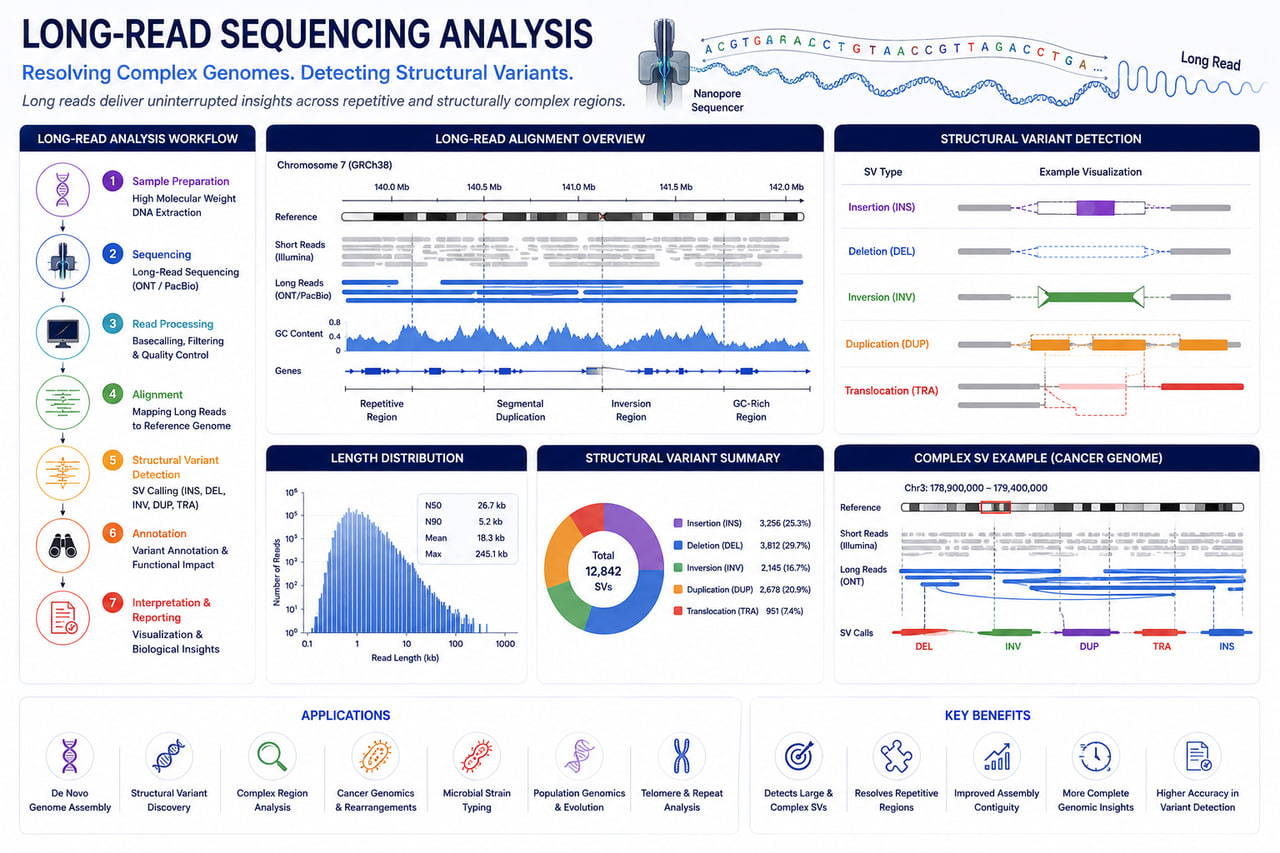
Long-Read Sequencing

RASA Life Science Informatics provides advanced Long-Read Sequencing analysis services to help researchers unlock complex genomic and transcriptomic insights that are difficult to resolve using conventional short-read sequencing technologies. Our bioinformatics workflows support Oxford Nanopore Technologies (ONT), PacBio HiFi, Iso-Seq, and hybrid sequencing approaches for comprehensive genome characterization and transcriptome analysis.

Long-read sequencing enables accurate detection of structural variants, repeat regions, complex genomic rearrangements, alternative splicing events, isoform diversity, and de novo genome assemblies. We help pharmaceutical companies, biotechnology organizations, hospitals, research institutes, CROs, and academic laboratories transform long-read sequencing data into actionable biological insights through scalable, cloud-ready, and reproducible bioinformatics pipelines.

Our services support applications in human genomics, cancer genomics, rare disease research, microbial genomics, plant genomics, precision medicine, and drug discovery.

Service Offerings

Long-Read Sequencing Services

Oxford Nanopore Sequencing Analysis

Comprehensive analysis of nanopore sequencing data for genomic and transcriptomic applications.

  • βœ“Basecalling and quality assessment
  • βœ“Read alignment and mapping
  • βœ“Structural variant detection
  • βœ“Long-read transcriptomics
  • βœ“Methylation analysis
  • βœ“Genome assembly

PacBio HiFi Sequencing Analysis

High-accuracy long-read analysis for genome characterization and variant discovery.

  • βœ“HiFi read processing
  • βœ“Variant discovery
  • βœ“Structural variant analysis
  • βœ“Haplotype phasing
  • βœ“Genome assembly
  • βœ“Transcript isoform analysis

Iso-Seq Transcriptomics Analysis

Full-length transcript sequencing for comprehensive transcriptome characterization.

  • βœ“Isoform discovery
  • βœ“Alternative splicing analysis
  • βœ“Novel transcript identification
  • βœ“Gene fusion detection
  • βœ“Transcript annotation
  • βœ“Differential isoform expression analysis

Structural Variant Analysis

Detection and characterization of large-scale genomic variations.

  • βœ“Insertions and deletions
  • βœ“Inversions
  • βœ“Duplications
  • βœ“Translocations
  • βœ“Copy number variations
  • βœ“Complex genomic rearrangements

De Novo Genome Assembly

Reference-free genome reconstruction using long-read sequencing data.

  • βœ“Genome assembly
  • βœ“Hybrid assembly
  • βœ“Assembly polishing
  • βœ“Scaffolding
  • βœ“Assembly quality assessment
  • βœ“Genome annotation support
Capabilities

Key Features

βœ“Oxford Nanopore & PacBio HiFi Expertise
βœ“Structural Variant Discovery
βœ“Isoform & Alternative Splicing Analysis
βœ“De Novo & Hybrid Genome Assembly
βœ“Methylation & Epigenetic Analysis
βœ“AI-Assisted Genomic Interpretation
βœ“Cloud-Ready Reproducible Pipelines
βœ“Publication-Ready Reports & Visualizations
Deliverables

Deliverables

Genomic Analysis Outputs

βœ“Structural Variant Reports
βœ“SNP & InDel Reports
βœ“Haplotype Phasing Results
βœ“Genome Assembly Statistics
βœ“Assembly Quality Metrics

Transcriptomics Outputs

βœ“Isoform Discovery Reports
βœ“Alternative Splicing Analysis
βœ“Novel Transcript Identification
βœ“Fusion Gene Reports
βœ“Differential Isoform Expression Analysis

Visualization & Reporting

βœ“Structural Variant Visualizations
βœ“Genome Assembly Reports
βœ“Transcript Isoform Maps
βœ“Publication-Ready Figures
βœ“Comprehensive Scientific Reports
Applications

Applications

Human Genomics

Rare disease research, precision medicine, and clinical genomics applications.

Cancer Genomics

Structural variant discovery and tumor genome characterization.

Transcriptomics

Full-length transcript sequencing and isoform analysis.

Microbial Genomics

Genome assembly, pathogen characterization, and comparative genomics.

Plant & Agricultural Genomics

Complex genome assembly and crop genomics research.

Drug Discovery

Target discovery, transcript characterization, and biomarker identification.

Technology

Technologies & Platforms

Long-Read Sequencing Platforms

Oxford Nanopore Technologies (ONT)
PacBio HiFi
PacBio Iso-Seq

Genome Assembly Tools

Flye
Canu
Shasta
Hifiasm
SPAdes Hybrid Assembly

Structural Variant Analysis

Sniffles
SVIM
cuteSV
pbsv

Transcriptomics Analysis

IsoSeq3
FLAIR
TALON
StringTie2

Infrastructure

Nextflow
Snakemake
Docker
AWS
Google Cloud
HPC Clusters
Highlights

Representative Analysis Outputs

Structural Variant Discovery

Detection of large genomic rearrangements not identifiable with short-read sequencing.

Genome Assembly

High-quality de novo and hybrid genome assemblies.

Full-Length Transcriptomics

Comprehensive characterization of transcript isoforms and alternative splicing events.

Rare Disease Analysis

Identification of clinically relevant structural variants and complex genomic alterations.

Biomarker Discovery

Detection of novel genomic and transcriptomic biomarkers.

Why RASA

Why Choose RASA?

AI-Assisted Bioinformatics

Machine learning-enabled workflows for biomarker discovery, variant prioritization, and predictive genomics.

Multi-Platform Expertise

Support for Illumina, Oxford Nanopore, PacBio HiFi, and 10x Genomics platforms.

End-to-End Analysis

From raw sequencing data to biological interpretation and publication-ready reports.

Cloud-Ready Infrastructure

Deployable on AWS, Google Cloud, HPC clusters, and secure on-premise environments.

Reproducible Workflows

Built using Nextflow, Snakemake, Docker, and Singularity for enterprise-grade bioinformatics operations.

Service FAQ

Frequently Asked Questions

Long-Read Sequencing is an advanced genomic sequencing technology that generates significantly longer DNA or RNA reads compared to traditional short-read sequencing methods. These long reads enable researchers to accurately resolve complex genomic regions, repetitive sequences, structural variants, haplotypes, and full-length transcript isoforms that are often difficult to characterize using short-read technologies.
Long-read sequencing has become a critical tool for genome assembly, structural variant discovery, transcriptomics, epigenomics, and precision medicine research.

Long-read sequencing offers several advantages over conventional short-read technologies, including:
Improved de novo genome assembly
Enhanced structural variant detection
Accurate haplotype phasing
Full-length transcript isoform identification
Better resolution of repetitive genomic regions
Detection of complex genomic rearrangements
Direct epigenetic modification analysis
Improved characterization of gene fusions and splice variants
These capabilities make long-read sequencing particularly valuable for complex genomic and transcriptomic studies.

RASA Life Science Informatics provides comprehensive long-read sequencing bioinformatics services including:
Oxford Nanopore Data Analysis
PacBio HiFi Analysis
PacBio Iso-Seq Analysis
Genome Assembly
Hybrid Genome Assembly
Structural Variant Analysis
Haplotype Phasing
Long-Read Transcriptomics
Isoform Discovery
Epigenetic Modification Analysis
Functional Annotation
Biomarker Discovery
Our workflows support research, clinical genomics, agriculture, biotechnology, and pharmaceutical applications.

Yes. We provide specialized analysis workflows for:
Oxford Nanopore Technologies (ONT)
Whole Genome Sequencing
Long-Read Transcriptomics
Direct RNA Sequencing
Methylation Analysis
Structural Variant Detection
PacBio HiFi
High-Accuracy Genome Sequencing
Variant Discovery
Genome Assembly
Haplotype Analysis
PacBio Iso-Seq
Full-Length Transcript Sequencing
Alternative Splicing Analysis
Isoform Discovery
Fusion Transcript Detection

Our long-read sequencing services support numerous research applications, including:
Genome Assembly
High-quality de novo and reference-guided genome assembly.
Structural Variant Analysis
Detection of insertions, deletions, inversions, duplications, and translocations.
Long-Read Transcriptomics
Comprehensive transcriptome characterization and gene expression analysis.
Isoform Discovery
Identification of novel transcripts and alternative splicing events.
Epigenetic Modification Analysis
Direct detection of DNA methylation and epigenetic signatures.
Clinical Genomics
Rare disease research, cancer genomics, and precision medicine studies.
Agricultural Genomics
Crop improvement, plant genomics, and livestock genetics research.

De novo genome assembly reconstructs an organism’s genome without relying on a reference genome. Long-read sequencing greatly improves assembly quality by spanning repetitive regions and resolving complex genomic structures.
This approach is particularly useful for:
Novel species characterization
Plant genomics
Microbial genomics
Comparative genomics
Agricultural research

Structural Variant (SV) analysis identifies large-scale genomic alterations that may influence disease development and biological function.
Common structural variants include:
Insertions
Deletions
Inversions
Duplications
Translocations
Copy Number Variations (CNVs)
Long-read sequencing is considered one of the most effective approaches for detecting structural variants accurately.

Iso-Seq is a PacBio long-read transcriptomics technology that sequences full-length RNA transcripts without assembly. This enables accurate characterization of:
Alternative Splicing Events
Novel Isoforms
Gene Fusions
Transcript Diversity
Long Non-Coding RNAs (lncRNAs)
Iso-Seq provides a more complete view of transcriptome complexity than short-read RNA sequencing.

Yes. Oxford Nanopore sequencing can directly detect epigenetic modifications such as DNA methylation without requiring additional chemical treatment.
Applications include:
Epigenetic Biomarker Discovery
Cancer Epigenomics
Developmental Biology
Regulatory Genomics
Precision Medicine Research

Haplotype phasing determines which genetic variants are inherited together on the same chromosome. Long-read sequencing enables highly accurate phasing, which is important for:
Rare Disease Research
Pharmacogenomics
Population Genetics
Clinical Genomics
Precision Medicine

Our workflows utilize industry-leading long-read bioinformatics tools, including:
Genome Assembly
Flye
Canu
Hifiasm
Shasta
SPAdes Hybrid Assembly
Structural Variant Analysis
Sniffles
SVIM
cuteSV
pbsv
Transcriptomics
IsoSeq3
FLAIR
TALON
StringTie2
Alignment & Processing
Minimap2
SAMtools
Nanopolish
Workflow Infrastructure
Nextflow
Snakemake
Docker
AWS
Google Cloud
HPC Clusters

We commonly support:
FASTQ Files
FAST5 Files
BAM Files
CRAM Files
VCF Files
GFF/GTF Annotation Files
Transcriptome Assemblies
Metadata Files
Custom formats can also be accommodated.

Typical deliverables include:
Quality Control Reports
Genome Assembly Reports
Assembly Statistics
Structural Variant Reports
Variant Annotation Reports
Isoform Discovery Reports
Alternative Splicing Analysis
Epigenetic Analysis Reports
Functional Annotation Results
Publication-Ready Figures
Comprehensive Scientific Reports
Deliverables are customized according to project objectives.

Long-read sequencing is widely used in:
Human Genomics
Cancer Genomics
Rare Disease Research
Precision Medicine
Agricultural Genomics
Microbial Genomics
Evolutionary Biology
Transcriptomics
Epigenomics
Drug Discovery
These applications benefit from the improved accuracy and genomic resolution offered by long-read technologies.

RASA combines expertise in genomics, bioinformatics, structural variant analysis, transcriptomics, and AI-assisted analytics to deliver scalable and reproducible long-read sequencing solutions. Our cloud-ready workflows, publication-ready reporting, and experience across healthcare, biotechnology, agriculture, and academic research help organizations unlock the full value of long-read sequencing data.
πŸ“§ info@rasalifesciences.com
🌐 www.rasalifesciences.com

Ready to partner with a trusted bioinformatics company in India?

Get in touch with our team in Pune, India to discuss sample sizes, platform details, and custom bioinformatics pipeline configurations for your research program.

Start a Project