
Computational Genomics & NGS

Epigenomics

AI-Powered Epigenomics Analysis Services for Gene Regulation, Chromatin Biology & Precision Medicine
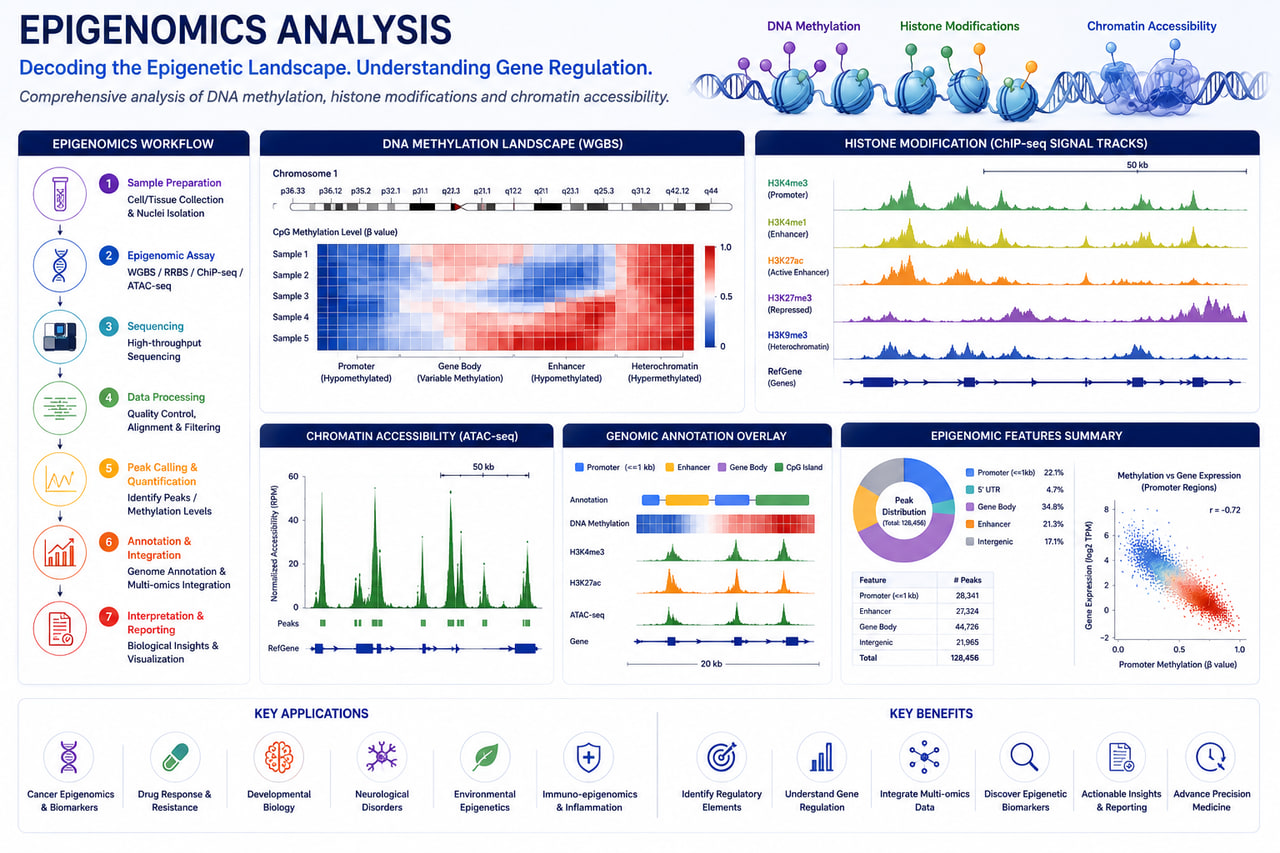
Epigenomics

RASA Life Science Informatics provides advanced Epigenomics analysis services that enable researchers to investigate gene regulation, chromatin accessibility, transcription factor activity, and epigenetic modifications underlying health and disease. Our comprehensive bioinformatics workflows support ChIP-Seq, ATAC-Seq, DNA Methylation Sequencing, Histone Modification Analysis, and Regulatory Genomics studies.

By integrating epigenomic, transcriptomic, and genomic datasets, we help pharmaceutical companies, biotechnology organizations, hospitals, CROs, research institutes, and academic laboratories uncover regulatory mechanisms, identify disease-associated epigenetic signatures, and accelerate biomarker discovery and therapeutic development.

Our scalable and reproducible pipelines support cancer epigenetics, immunology, neuroscience, developmental biology, stem cell research, rare diseases, and precision medicine programs.

Service Offerings

Epigenomics Services

ATAC-Seq Analysis

Characterize chromatin accessibility and identify regulatory regions across the genome.

  • βœ“Peak calling and quality assessment
  • βœ“Differential accessibility analysis
  • βœ“Open chromatin identification
  • βœ“Regulatory element discovery
  • βœ“Motif enrichment analysis
  • βœ“Transcription factor activity prediction

ChIP-Seq Analysis

Map protein-DNA interactions and regulatory binding sites.

  • βœ“Peak detection and annotation
  • βœ“Histone modification analysis
  • βœ“Transcription factor binding analysis
  • βœ“Differential binding analysis
  • βœ“Genome-wide occupancy profiling
  • βœ“Regulatory network construction

DNA Methylation Analysis

Investigate epigenetic modifications associated with development, disease, and therapeutic response.

  • βœ“Differential methylation analysis
  • βœ“CpG island analysis
  • βœ“Methylation pattern profiling
  • βœ“Epigenetic biomarker discovery
  • βœ“Gene regulation studies
  • βœ“Clinical methylation analysis

Histone Modification Analysis

Explore chromatin states and regulatory mechanisms.

  • βœ“Histone mark profiling
  • βœ“Chromatin state characterization
  • βœ“Enhancer and promoter analysis
  • βœ“Epigenetic landscape mapping
  • βœ“Regulatory region annotation

Regulatory Genomics

Integrate epigenomic and transcriptomic data to understand gene regulation.

  • βœ“Gene regulatory network analysis
  • βœ“Multi-omics integration
  • βœ“Regulatory pathway analysis
  • βœ“Functional annotation
  • βœ“Biomarker discovery
Capabilities

Key Features

βœ“ATAC-Seq & ChIP-Seq Expertise
βœ“DNA Methylation Analysis
βœ“Histone Modification Profiling
βœ“Regulatory Genomics & Gene Regulation Studies
βœ“Multi-Omics Integration
βœ“AI-Assisted Epigenomic Interpretation
βœ“Cloud-Ready Reproducible Pipelines
βœ“Publication-Ready Reports & Visualizations
Deliverables

Deliverables

Epigenomic Analysis Outputs

βœ“Peak Calling Reports
βœ“Differential Accessibility Reports
βœ“Differential Methylation Reports
βœ“Histone Modification Profiles
βœ“Regulatory Region Annotations

Functional Analysis Outputs

βœ“Motif Enrichment Analysis
βœ“Transcription Factor Activity Reports
βœ“Pathway Enrichment Analysis
βœ“Regulatory Network Maps
βœ“Epigenetic Biomarker Reports

Visualization & Reporting

βœ“Genome Browser Tracks
βœ“Peak Distribution Plots
βœ“Heatmaps & Clustering Analysis
βœ“Chromatin Accessibility Maps
βœ“Publication-Ready Figures
βœ“Comprehensive Scientific Reports
Applications

Applications

Cancer Epigenomics

Identification of epigenetic drivers, biomarkers, and therapeutic targets in oncology.

Immunology Research

Analysis of immune cell regulation and chromatin accessibility.

Neuroscience

Investigation of epigenetic mechanisms involved in neurological disorders.

Stem Cell & Developmental Biology

Understanding cellular differentiation and developmental regulation.

Precision Medicine

Epigenetic biomarker discovery and patient stratification.

Drug Discovery

Identification of regulatory pathways and therapeutic targets.

Technology

Technologies & Platforms

ATAC-Seq & ChIP-Seq Analysis

MACS2
HOMER
ChIPseeker
DiffBind
deepTools

DNA Methylation Analysis

Bismark
methylKit
DSS
BS-Seeker2

Functional Annotation

GREAT
MEME Suite
JASPAR
Gene Ontology (GO)
KEGG

Infrastructure

Nextflow
Snakemake
Docker
AWS
Google Cloud
HPC Clusters
Highlights

Representative Analysis Outputs

Chromatin Accessibility Profiling

Identification of open chromatin regions and regulatory elements.

Transcription Factor Analysis

Discovery of regulatory binding sites and transcriptional regulators.

DNA Methylation Profiling

Characterization of disease-associated methylation patterns.

Histone Modification Mapping

Analysis of chromatin states and epigenetic regulation.

Epigenetic Biomarker Discovery

Identification of diagnostic, prognostic, and therapeutic biomarkers.

Why RASA

Why Choose RASA?

AI-Assisted Bioinformatics

Machine learning-enabled workflows for biomarker discovery, variant prioritization, and predictive genomics.

Multi-Platform Expertise

Support for Illumina, Oxford Nanopore, PacBio HiFi, and 10x Genomics platforms.

End-to-End Analysis

From raw sequencing data to biological interpretation and publication-ready reports.

Cloud-Ready Infrastructure

Deployable on AWS, Google Cloud, HPC clusters, and secure on-premise environments.

Reproducible Workflows

Built using Nextflow, Snakemake, Docker, and Singularity for enterprise-grade bioinformatics operations.

Service FAQ

Frequently Asked Questions

Epigenomics is the study of chemical modifications and regulatory mechanisms that influence gene expression without altering the underlying DNA sequence. These epigenetic changes help determine when, where, and how genes are activated or silenced. Epigenomics plays a critical role in development, cellular differentiation, disease progression, aging, and therapeutic response.
By analyzing epigenetic markers such as DNA methylation, chromatin accessibility, histone modifications, and transcription factor binding sites, researchers can gain deeper insights into gene regulation and disease biology.

RASA Life Science Informatics offers comprehensive epigenomics analysis services including:
ATAC-Seq Analysis
ChIP-Seq Analysis
DNA Methylation Analysis
Histone Modification Profiling
Chromatin Accessibility Analysis
Differential Binding Analysis
Peak Calling & Annotation
Transcription Factor Binding Analysis
Regulatory Network Analysis
Epigenetic Biomarker Discovery
Multi-Omics Integration
Our workflows support pharmaceutical research, biotechnology innovation, cancer genomics, precision medicine, and academic research programs.

ATAC-Seq (Assay for Transposase-Accessible Chromatin using Sequencing) is a technique used to identify open chromatin regions across the genome. These accessible regions often contain promoters, enhancers, and regulatory elements that control gene expression.
ATAC-Seq analysis helps researchers:
Identify active regulatory regions
Study transcription factor activity
Characterize cell-type specific regulation
Investigate disease-associated epigenetic changes

Chromatin Immunoprecipitation Sequencing (ChIP-Seq) is used to identify DNA regions bound by specific proteins such as transcription factors or histone modifications.
ChIP-Seq enables researchers to:
Map transcription factor binding sites
Study gene regulation
Identify enhancer and promoter regions
Investigate chromatin states
Understand disease-associated regulatory mechanisms

DNA methylation analysis measures methyl groups attached to DNA molecules, typically at CpG sites. DNA methylation is one of the most important epigenetic mechanisms controlling gene expression.
Applications include:
Cancer Epigenetics
Aging Research
Developmental Biology
Precision Medicine
Biomarker Discovery

Histone modification profiling identifies chemical modifications on histone proteins that regulate chromatin structure and gene activity.
Common histone marks include:
H3K27ac
H3K4me3
H3K27me3
H3K9me3
These modifications help researchers understand gene activation, repression, and chromatin organization.

Yes. We routinely integrate epigenomics and transcriptomics datasets to provide systems-level insights into gene regulation.
Common integrations include:
ATAC-Seq + RNA-Seq
ChIP-Seq + RNA-Seq
DNA Methylation + RNA-Seq
Single-Cell Multiome Analysis
This approach helps identify regulatory mechanisms that drive gene expression changes and disease progression.

Epigenomics has become a critical component of research across multiple disease areas, including:
Cancer
Understanding tumor progression, drug resistance, and epigenetic biomarkers.
Neurological Disorders
Studying Alzheimer’s disease, Parkinson’s disease, autism spectrum disorders, and neurodevelopmental conditions.
Autoimmune Diseases
Investigating immune dysregulation and inflammatory pathways.
Developmental Disorders
Understanding gene regulation during embryonic development and congenital diseases.
Cardiovascular Diseases
Identifying epigenetic factors contributing to heart disease and vascular disorders.
Metabolic Disorders
Investigating obesity, diabetes, and metabolic syndrome.

A standard epigenomics workflow may include:
Quality Control
Sequence Alignment
Peak Calling
Peak Annotation
Differential Accessibility Analysis
Differential Binding Analysis
Motif Enrichment Analysis
Regulatory Network Analysis
Functional Enrichment Analysis
Multi-Omics Integration
Biological Interpretation
Scientific Reporting

Peak calling is the process of identifying genomic regions enriched for sequencing reads. These peaks often represent biologically important regulatory elements such as transcription factor binding sites, enhancers, promoters, and chromatin accessibility regions.
Peak calling is a critical step in both ATAC-Seq and ChIP-Seq workflows.

Motif enrichment analysis identifies DNA sequence patterns that are recognized by transcription factors. This analysis helps researchers discover key regulatory proteins and gene regulatory networks involved in biological processes and disease mechanisms.

Our workflows utilize industry-leading epigenomics software, including:
ATAC-Seq & ChIP-Seq Analysis
Bowtie2
BWA
MACS2
HOMER
DeepTools
DNA Methylation Analysis
Bismark
MethPipe
methylKit
DSS
Functional & Network Analysis
ChIPseeker
ClusterProfiler
Cytoscape
GREAT
Workflow Infrastructure
Nextflow
Snakemake
Docker
AWS
Google Cloud

We commonly support:
FASTQ Files
BAM Files
CRAM Files
BED Files
Peak Files
Methylation Reports
Count Matrices
Metadata Files
Our team can also accommodate custom project-specific formats.

Typical deliverables include:
Quality Control Reports
Peak Calling Reports
Differential Accessibility Analysis
Differential Binding Analysis
DNA Methylation Reports
Motif Enrichment Results
Regulatory Network Analysis
Pathway Enrichment Reports
Epigenetic Biomarker Discovery Reports
Publication-Ready Figures
Comprehensive Scientific Reports
Deliverables are customized according to project objectives.

RASA combines expertise in genomics, epigenetics, bioinformatics, systems biology, and AI-driven analytics to deliver scalable and reproducible epigenomics solutions. Our advanced workflows, cloud-ready infrastructure, publication-ready reporting, and experience across oncology, neuroscience, immunology, and precision medicine help researchers unlock meaningful insights from epigenetic datasets.
πŸ“§ info@rasalifesciences.com
🌐 www.rasalifesciences.com

Ready to partner with a trusted bioinformatics company in India?

Get in touch with our team in Pune, India to discuss sample sizes, platform details, and custom bioinformatics pipeline configurations for your research program.

Start a Project